.svg)
.png)
.svg)
.svg)
.svg)


A design subscription service is a recurring plan that gives a company ongoing access to a design team — UX/UI, brand, web, and marketing design — instead of hiring in-house or scoping one-off freelance projects. Structures vary: some providers cap how many requests can be "active" at once, others sell a monthly hours allotment with a committed response time (an SLA) for picking up new tasks. Either way, you get continuous design capacity without paying per project or making a full-time hire. For teams that need design every week but not enough to justify a full-time hire, it's become the default alternative to both freelance one-offs and building an internal team from scratch.
This guide breaks down how the model actually works, what it costs, where AI genuinely changes the picture in 2026 (and where it doesn't), and what to check before picking a provider.
How a design subscription service works
Every provider structures the mechanics slightly differently, but two models dominate the category:
- Request-queue model. You submit tasks — a landing page, a set of app screens, a pitch deck, an ad set — through a shared board, and the team works through them in order, with a cap on how many requests are "active" at once (commonly one or two). You give up parallel throughput in exchange for a flat price and continuous output.
- Hours-with-SLA model. You buy a monthly hours allotment instead of a request-count cap, paired with a committed turnaround for picking up new work — for example, a 1-2 business day SLA to start a task once it's submitted. Hours are drawn down as work happens; unused hours typically don't roll over, so the incentive is to actually use the allotment each month rather than bank it.
- Fixed or near-fixed turnaround. Whichever model, most providers quote a turnaround window rather than promising instant delivery — either per-request delivery time, or an SLA for how fast a submitted task gets picked up.
- Pause or cancel monthly. Unlike a full-time hire, most subscriptions are month-to-month, which is the main pitch versus hiring.
The trade-off in both models is the same shape: you give up unlimited parallel output, and in exchange you get design capacity at a fraction of what an in-house team of the same output would cost.
Design subscription vs. freelancer vs. in-house team
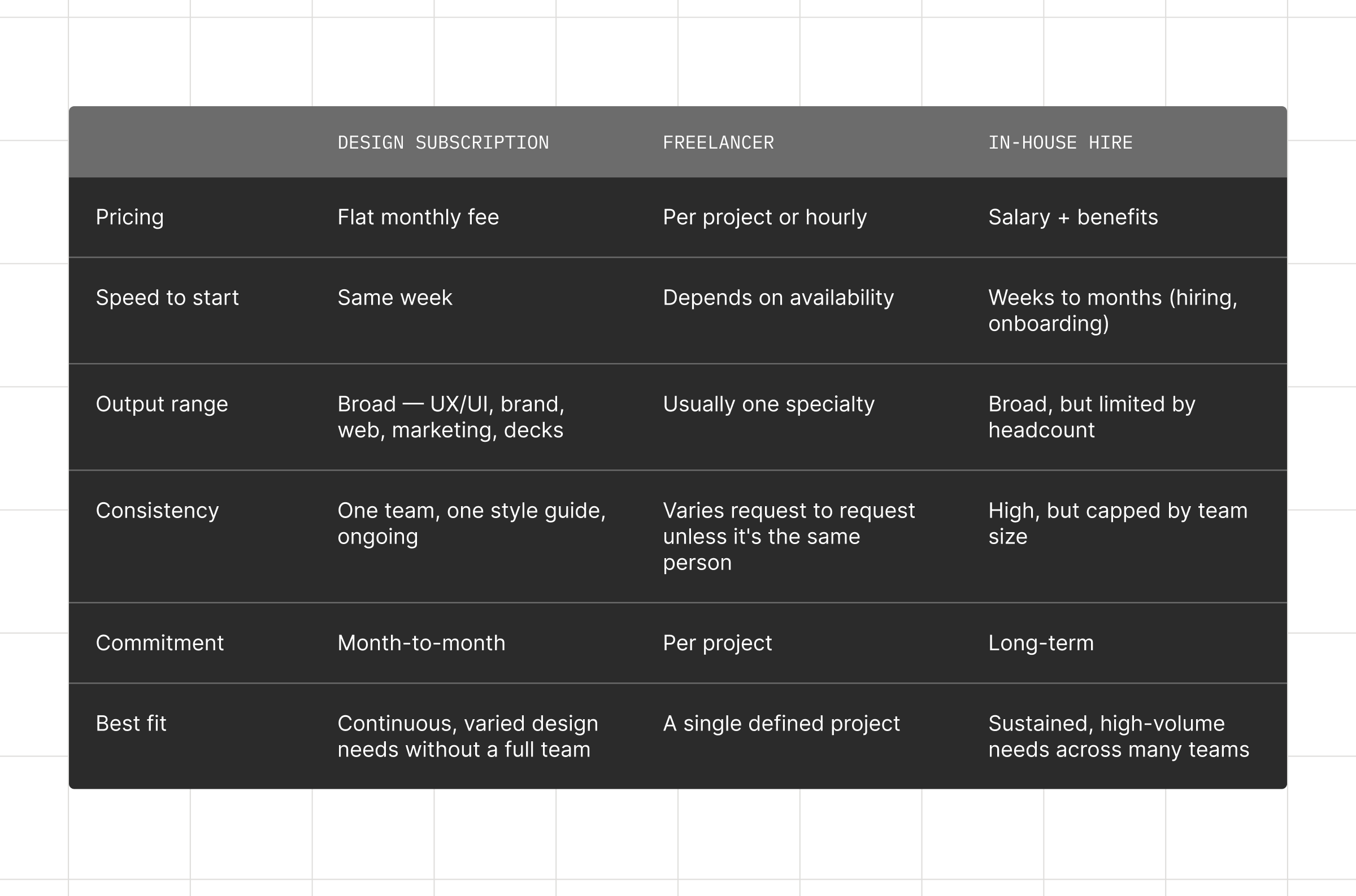
The subscription model sits between the other two: more consistent and broader in scope than rotating freelancers, more flexible and faster to start than a full-time hire.
How much does a design subscription cost
Pricing depends on which model a provider uses. Request-queue plans are usually tiered by how many requests run in parallel; hours-based plans are priced by the monthly hours allotment and the SLA attached to it.
INSAIM's own subscription, for example, runs on the hours model: a monthly fee buys a set number of design hours plus a committed SLA to pick up a submitted task. Hours don't roll over — unused hours in a given month expire rather than carrying forward, so the plan is built around steady, ongoing use rather than banking capacity for occasional bursts. Ad hoc or time-and-materials engagements outside the subscription commitment work differently: availability depends on the team's current workload, with a longer, non-guaranteed turnaround rather than the subscription's committed SLA.
Compared to hiring a single in-house product designer full-time — salary plus benefits, tooling, and management overhead — a subscription at this price point typically costs less than the fully-loaded cost of one hire, while covering a broader range of design work than one person usually specializes in.
Where AI actually fits into a design subscription in 2026
AI hasn't replaced the core value of a design subscription — a team that understands your product, your brand, and your users well enough to make good design decisions without a lengthy brief. What it has changed is the shape of the work inside the subscription itself.
The providers that have adapted are using AI as a tool within the workflow, not as a replacement for the designer:
- Faster first drafts. AI-assisted layout and image generation compress the time between "request submitted" and "first version to review," which matters directly for a model priced on turnaround speed.
- Asset generation at scale. AI image and illustration generation covers the volume work (icon sets, background art, ad variations) that used to eat hours a human designer would otherwise spend on production rather than decisions.
- Automation of repetitive production steps. Resizing a campaign across a dozen ad formats, generating localized variants, or batch-exporting assets is increasingly automated, freeing designer time for the parts of a request that actually need judgment — hierarchy, usability, brand fit.
- AI video and motion. Short-form product and marketing video, previously a separate specialty most subscriptions didn't cover well, is now realistically in scope for teams that have built AI video generation into their process.
What hasn't changed: a request still needs a human designer to interpret it correctly, catch what a generic AI output gets wrong for your specific product or brand, and make the judgment calls a prompt can't. The subscriptions worth paying for in 2026 use AI to move faster through production, not to skip the design thinking — a queue that just routes your request straight to an image generator isn't a design subscription, it's a prompt box with a monthly invoice.
INSAIM's own subscription builds this in directly: AI automation, AI-generated imagery and illustration, and AI video generation are part of the standard workflow within the plan's hours allotment and SLA, not a separate add-on — the same designers reviewing and refining the output, not an unsupervised pipeline.
Who a design subscription service actually fits
- Startups post-seed funding that need consistent design output — landing pages, product screens, pitch decks — but aren't ready to hire a design lead yet.
- SaaS and product teams shipping features on a regular cadence who need UI work faster than an internal design team (if one even exists) can turn around.
- Marketing teams running an ongoing stream of campaign assets, ad variations, and social creative that would otherwise mean juggling multiple freelancers.
- Agencies and consultancies that need design capacity for client work without carrying full-time design headcount.
It fits less well for a single, tightly-scoped project with a hard deadline (a freelancer or project-based agency engagement is usually a better match), or for a company that needs a designer embedded daily in product meetings and sprint planning — that's an in-house hiring problem a subscription doesn't solve.
How to evaluate a design subscription service before signing up
- Ask what "unlimited" actually means. Most plans market "unlimited design requests," but the real constraint is either how many requests run in parallel (usually one or two) or how many hours are included per month and whether unused hours roll over. Confirm which model a provider uses and the actual number before comparing price across providers.
- Check the portfolio for your specific category. A team strong in brand identity work isn't automatically strong in complex SaaS UX — ask for examples in your specific design need (app UI, e-commerce, brand systems).
- Confirm turnaround in writing, not just "fast" as a marketing claim — get the actual quoted window for standard vs. complex requests.
- Understand the pause/cancel policy — month-to-month is standard, but some providers require notice periods or lock in a minimum term.
- Ask how revisions work — unlimited revisions within a request is standard; unlimited new requests is not the same thing, and providers sometimes blur this in marketing copy.
FAQ
- How much is a design subscription?
It depends on the model. Request-queue plans are priced by how many requests run in parallel; hours-based plans are priced by the monthly hours allotment and SLA. INSAIM's plan, for example, is priced as a monthly fee for a set number of design hours with a committed SLA to pick up a task. - What does "unlimited" mean in a design subscription?
It usually refers to the number of requests you can submit over time, not how many are worked on simultaneously or how many hours they take — request-queue plans still cap active, in-progress work at one or two items at a time, and hours-based plans cap the total hours available each month. - How much does a graphic design subscription cost per month?
It depends on the provider's model — request-queue plans price by parallel-request capacity, hours-based plans price by the hours allotment and SLA. INSAIM's own plan is priced this way, as a monthly fee for a fixed hours allotment and SLA. - Is a design subscription cheaper than hiring a designer?
For most companies, yes — a subscription typically costs less than the fully-loaded cost of a single in-house hire (salary, benefits, tooling, management time), while covering a broader range of design specialties than one person usually has.
Where to go from here
If continuous design capacity — without the overhead of a full hire — is what you're evaluating, INSAIM's own design subscription covers UX/UI, brand, and web design through a monthly hours allotment and committed SLA, with AI-assisted production built into the workflow and reviewed by the same design team on every task.