.svg)
.png)
.svg)
.svg)
.svg)


Embedding privacy by design healthtech into your digital health products isn’t just good practice — it’s essential for meeting data privacy compliance obligations, building trust with users, and avoiding costly rework or regulatory penalties.
In this guide, we pull together the core global frameworks that inform privacy by design in healthcare — including HIPAA, HITECH, GDPR Article 25, and ISO standards (27001 and 27799) — and translate them into actionable steps for startups and product teams driving privacy-first product development.
Why Privacy by Design Matters in Healthtech
Health data is among the most sensitive personal data categories globally — meaning privacy requirements are stringent and enforced across geographies. Privacy by design calls for embedding privacy and security measures into products from day one — before data is collected or processed — and by default throughout the entire product lifecycle.
For healthtech startups, this approach reduces regulatory risk under HIPAA, GDPR, and HITECH, builds trust with users and partners, and aligns product features with global best practices from the outset rather than as a retrofit.
Core Regulatory Frameworks for Privacy by Design in Healthtech
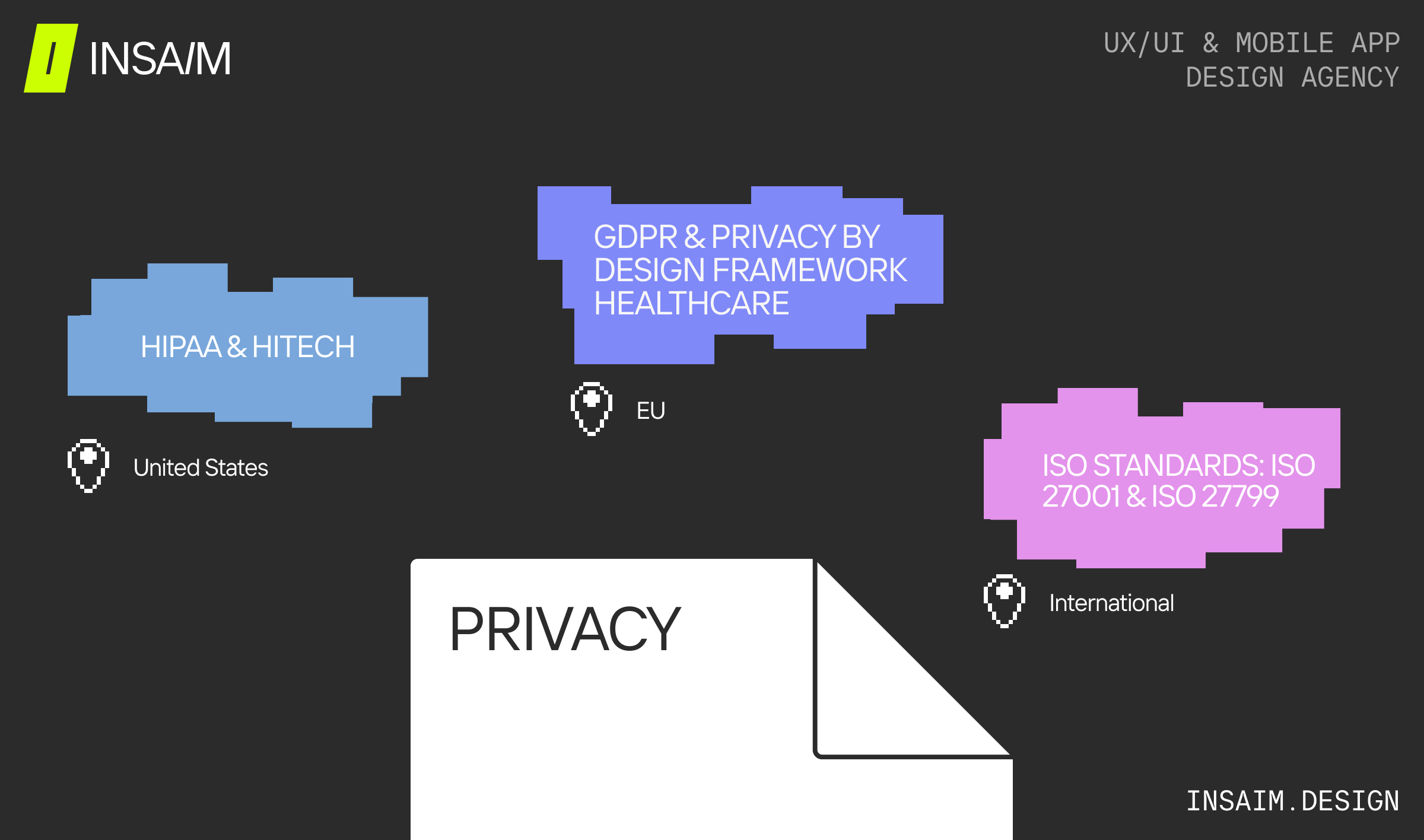
1. HIPAA & HITECH (United States)
HIPAA requires that any system handling Protected Health Information (PHI) implement privacy and security safeguards throughout design and operation. These safeguards include technical protections such as access controls and encryption, administrative processes including risk analysis and workforce training, and physical safeguards governing device access.
HIPAA also mandates Business Associate Agreements with vendors handling PHI, ensuring third-party services implement appropriate safeguards.
The HITECH Act enhances HIPAA by increasing breach notification requirements and enforcement actions. This means privacy engineering practices must be demonstrable and auditable from design through deployment — not just documented in a policy. (Inquira — HIPAA & GDPR compliance)
For HIPAA-compliant product design, the non-negotiables are strong authentication, encryption in transit and at rest, and rigorous audit logging.
2. GDPR & Privacy by Design Framework Healthcare (EU)
In the EU, privacy by design obligations stem directly from Article 25 of the GDPR, which requires that privacy protections be embedded into processing operations and information systems by design and by default. Controllers must implement appropriate technical and organisational measures that demonstrate compliance with the regulation's data protection principles throughout the entire processing lifecycle — not only at launch.
Article 25 breaks into two obligations. The first requires privacy to be built into the architecture of processing systems at the time of design. The second requires that, by default, only the minimum necessary personal data is collected and processed — without any action required from the user. Both apply simultaneously. (EDPB Guidelines 4/2019 on Article 25)
Practical measures include data minimisation and purpose limitation, pseudonymisation where feasible, strong default privacy settings, and consent management with clear data subject rights mechanisms.
3. ISO Standards: ISO 27001 & ISO 27799 (International)
ISO 27001 is a certification standard for establishing, maintaining, and continually improving an Information Security Management System. It defines requirements for managing information risk systematically and provides the overarching governance framework within which security controls are implemented. ISO 27001 does not prescribe specific controls — that is the role of ISO 27002, which serves as the detailed controls catalogue.
ISO 27799:2025 is a healthcare-specific extension built on ISO/IEC 27002:2022. It provides information security controls and implementation guidance specifically for health organisations — covering electronic health record systems, medical devices incorporating health software, and both on-premises and cloud-based environments. The 2025 edition replaces ISO 27799:2016 and has been updated to align with the revised structure of ISO 27002:2022. (ISO 27799:2025)
Together, ISO 27001 and ISO 27799 help startups structure privacy engineering practices in a framework familiar to auditors and enterprise partners — and in some markets, ISO 27799 certification is specifically required for health institutions.
HIPAA vs GDPR: Key Differences for Teams Building Across Markets
Teams building products for both US and EU markets frequently underestimate how differently these two frameworks approach the same problems. Understanding where they diverge matters for product architecture, consent flows, and breach response planning.
- Legal basis for processing. HIPAA operates on a treatment, payment, and operations model — if processing PHI falls within those defined purposes, it is generally permitted without separate user consent. GDPR requires a specific legal basis for every processing activity. In health contexts, that is typically explicit consent or the processing of special category data under Article 9(2), which has stricter requirements than standard consent.
- Consent architecture. Under HIPAA, many disclosures of PHI are permitted without patient authorisation. Under GDPR, consent must be freely given, specific, informed, and unambiguous — and users must be able to withdraw it as easily as they gave it. This has direct implications for how opt-in flows, data sharing toggles, and account deletion features are designed.
- Breach notification timelines. HIPAA requires notification to affected individuals within 60 days of discovering a breach. GDPR requires notification to the relevant supervisory authority within 72 hours — a significantly tighter window that demands a more automated and well-rehearsed incident response process.
- Data minimisation. Both frameworks require collecting only the data necessary for the stated purpose, but GDPR enforces this more prescriptively. Under Article 25(2), data minimisation is a by-default obligation — not a design recommendation.
For teams operating across both jurisdictions, the practical approach is to design to GDPR's stricter standards by default. This generally satisfies HIPAA requirements, though specific HIPAA technical safeguards — such as audit controls and automatic logoff — must still be addressed explicitly.
Best Practices: Embedding Privacy by Design into Product Development
Implementing privacy by design is a systematic engineering discipline, not a compliance checkbox. Key principles include embedding privacy from inception into system architecture, minimising personal data collection across all workflows, designing user experiences that make privacy controls clear and accessible, and making privacy the default without requiring user intervention.

Integration With Product & UX
Good privacy UX and privacy-first product design healthcare practices include:
- Opt-in privacy settings
- Clearly explained consent and data use terms
- Incremental permissions tied to specific features
- Granular user control over data sharing
For broader product strategy context, see INSAIM’s insights on building user-centered products Design-Driven Development: How to Build User-Centered Products That Succeed
Privacy by Design for AI-Driven Health Products
AI introduces specific privacy challenges that standard frameworks do not fully address — and this is an area where many healthtech teams underinvest until late in development.
AI models trained on health data inherit the sensitivity of that data. A model that has learned from identifiable patient records can in some cases re-identify individuals even when the training data has been anonymised. This makes data minimisation during model training a privacy engineering concern, not just a data governance one.
For teams building AI-driven health products, the key principles are:
- Minimise PHI in training data from the start. If a model can be trained on synthetic or pseudonymised data without significant loss of performance, that is the preferred path. Reducing PHI in training data simplifies compliance with both HIPAA and GDPR, and reduces the blast radius of a future breach.
- Document model decisions that affect users. GDPR Article 22 gives individuals the right not to be subject to solely automated decisions that significantly affect them. In a health context — where an AI might flag a risk score, recommend a care pathway, or deny access to a service — this right is particularly relevant. Product teams should build explainability and human review into high-stakes AI outputs from the design stage.
- Treat model outputs as personal data. Predictions, risk scores, and inferences derived from health data are themselves sensitive. They should be subject to the same access controls, retention policies, and deletion rights as the underlying data.
If you’re building an AI-driven health product or an MVP that handles health data, reducing unnecessary PHI early in design simplifies compliance with both HIPAA and GDPR privacy by design healthcare principles — and can reduce costs and technical complexity. For practical advice on this approach, see this resource for startups: Privacy by Design for MVP (AI Healthcare Compliance)
Healthtech Data Privacy Best Practices
For digital health teams bringing products to market efficiently and with a strong privacy posture:
- Conduct threat modelling and secure design reviews before writing production code
- Run automated security testing early and continuously, not only before release
- Update Data Protection Impact Assessments as products evolve, not only at launch
- Plan data lifecycle from the start — including retention limits and secure deletion
- Conduct vendor risk assessments ensuring all third parties comply with HIPAA, GDPR, and relevant ISO frameworks
- Apply pseudonymisation, differential privacy, and federated analytics where they strengthen privacy without compromising analytics utility
Privacy by Design Healthtech Implementation Checklist

Use this checklist to operationalise privacy by design healthtech across product stages:
Product Strategy
- Data purpose & scope documents completed
- Legal basis & user rights mapped (GDPR / HIPAA)
- DPIA completed for high-risk processing (GDPR)
- Consent model designed and documented
Technical & Engineering
- Data minimisation enforced in schemas & APIs
- Encryption implemented where appropriate (e.g., TLS 1.3 for transit, AES-256 for data at rest) based on risk and regulatory requirements.
- Pseudonymisation where possible
- Most privacy-protective settings are enabled by default
- Logging & audit trails enabled for sensitive actions
Security & Standards
- ISO 27001 ISMS in place (controls aligned)
- ISO 27799-aligned health informatics controls applied
- Access control policies (RBAC/ABAC) enforced
- BAA / data processing agreements in place
UX & User Controls
- Clear consent UI/UX
- Granular permission options
- Privacy policy linked in-app with easy language
Operations & Monitoring
- Continuous monitoring & incident response documented
- Vendor & third-party compliance assessments
- Routine privacy & security reviews