.svg)
.png)
.svg)
.svg)
.svg)


The wellness app market continues to grow, offering users more tools than ever for improving sleep, nutrition, physical activity, and overall wellbeing. But attracting users to a product is only half the challenge. Keeping them coming back is significantly harder.
Users come to wellness apps wanting to improve their health, sleep, energy levels, or build better habits. Yet within the first few weeks, many stop using the product entirely — initial motivation fades before the habit of regularly returning to the app has had a chance to form. The first 7 days of use are particularly critical. This is the window in which a user decides whether the app will become part of their daily life or remain just another icon on their phone. If within that first week they don't see value, don't experience early results, or don't understand how the product helps them reach their goals, the likelihood of churn increases dramatically. That's why successful wellness apps focus not only on user acquisition, but on creating an experience that helps people feel the benefit quickly, build a habit, and sustain motivation over the long term.
Why Users Abandon Wellness Apps
Most wellness apps lose users within the first few weeks. The core reason is simple: the product demands regular action — filling in journals, marking habits, analyzing metrics — but doesn't help users see results quickly enough.
Psychologically, people tend to repeat actions that produce a clear reward. If a user spends time on tracking but doesn't understand how it affects their health or brings them closer to a goal, motivation gradually erodes.
Digital fatigue makes this worse. Most smartphone interactions already compete for the user's attention, so any additional required action is perceived as a burden. Manual data entry and complex flows are among the most common reasons people abandon apps altogether.
In response, modern wellness products increasingly rely on automatic data collection and personalized insights. The less effort required from the user, and the faster they receive a useful recommendation or see progress, the more likely the app is to become part of their everyday life.
Engagement Anti-Patterns in Wellness Products
Before exploring the features that improve user engagement in wellness apps, it's worth understanding what drives users away. These anti-patterns appear consistently across products that struggle with retention.
Bugs, Instability, and Internet Dependency
The most obvious — and unfortunately one of the most common — ways to lose a user is forcing them to encounter a bug at the exact moment a habit is forming. If the app loads slowly, doesn't work without a stable connection, loses data, or fails to sync properly with devices, trust disappears faster than the motivation to start fresh on Monday.
In wellness products, users are entrusting the app with their habits, health metrics, and personal progress. Any failure calls the value of that tracking into question. Why invest time in data that might disappear tomorrow?
Complex UX and Unnecessary Steps
One of the most widespread mistakes is turning health management into additional work. Every extra screen, required field, or unnecessary tap increases the likelihood that the user will put the action off until later — and then forget about it entirely.
This is especially critical for daily use scenarios. An action that needs to be repeated every day should take seconds, not minutes. The less effort required to enter data and receive a result, the more likely tracking is to become a habit. The best UX in wellness apps is the kind that's almost invisible to the user.
Data Overload
It seems logical that more data means more value. In practice, the opposite is true. Dozens of metrics, charts, and indicators create noise and complicate decision-making. Most users don't need another graph — they need an answer to a simple question: "What should I do next?" The best wellness products are gradually shifting focus from displaying data to interpreting it.
Excessive Push Notifications
Notifications help bring users back into the app, but only when they carry genuine value. If a product reminds users of itself too frequently, they quickly learn to ignore the messages. In the best case, notifications get disabled. In the worst case, the app gets deleted. Every notification should help the user achieve a goal — not simply compete for their attention.
Manual Data Entry
Manual input is one of the biggest enemies of long-term retention. Users are willing to fill in food diaries, mark habits, and log readings at first — but enthusiasm inevitably fades over time. The more actions an app requires, the higher the likelihood of abandoning tracking altogether. That's why modern wellness products aim to automate data collection and reduce required interactions to an absolute minimum.
Gamification for Its Own Sake
Gamification in health apps is a widely used strategy — but it only works when rewards are connected to real behavioral change. Badges, levels, and day streaks can attract attention, but they rarely retain users for long when disconnected from meaningful progress. What matters to users isn't growth in virtual achievements, but their own real results: better sleep, lower stress levels, a habit that's actually forming.
Overcomplicated Daily Flows
Most wellness apps are built around actions that need to be repeated every day. That's precisely why even small inconveniences become serious barriers over time. If completing a simple task requires navigating several screens, filling out a form, and confirming an action, users will eventually start skipping it. The best products make daily interaction so simple it becomes an almost invisible part of the user's existing routine.
What Actually Drives Engagement
Users come for health tracking, but they only stay when they begin to trust the conclusions the product draws.
Before getting into specific features that improve user engagement in wellness apps, one thing is worth stating clearly: no push notifications, streaks, badges, or AI coaches can retain a user if the product itself doesn't deliver real value. As with any business, the foundation of long-term engagement is the quality of the core service.
In wellness apps, this matters especially. Users are entrusting the product with their health data and expecting useful insights and recommendations in return. Engagement is therefore directly tied to how accurately data is collected, how well it's interpreted, and how clearly recommendations are communicated to an ordinary person. Even the most advanced metrics lose their value if users don't understand what they mean or how to apply them in everyday life.
When a product genuinely helps people better understand their own state, make more informed decisions, and see the connection between their actions and outcomes — engagement becomes a natural consequence of the value being delivered. Everything else — habit formation, personalization, gamification, social features, AI assistants — works on top of that foundation.
Looking at market leaders, certain patterns repeat consistently. They combine simple daily check-in flows, clear progress visualization, personalized recommendations, regular reports, light gamification, and tools for reflection. Rather than demanding more from users, these products help them better understand themselves and see the results of their efforts.
Features That Improve User Engagement in Wellness Apps
Progress Tracking UX Design
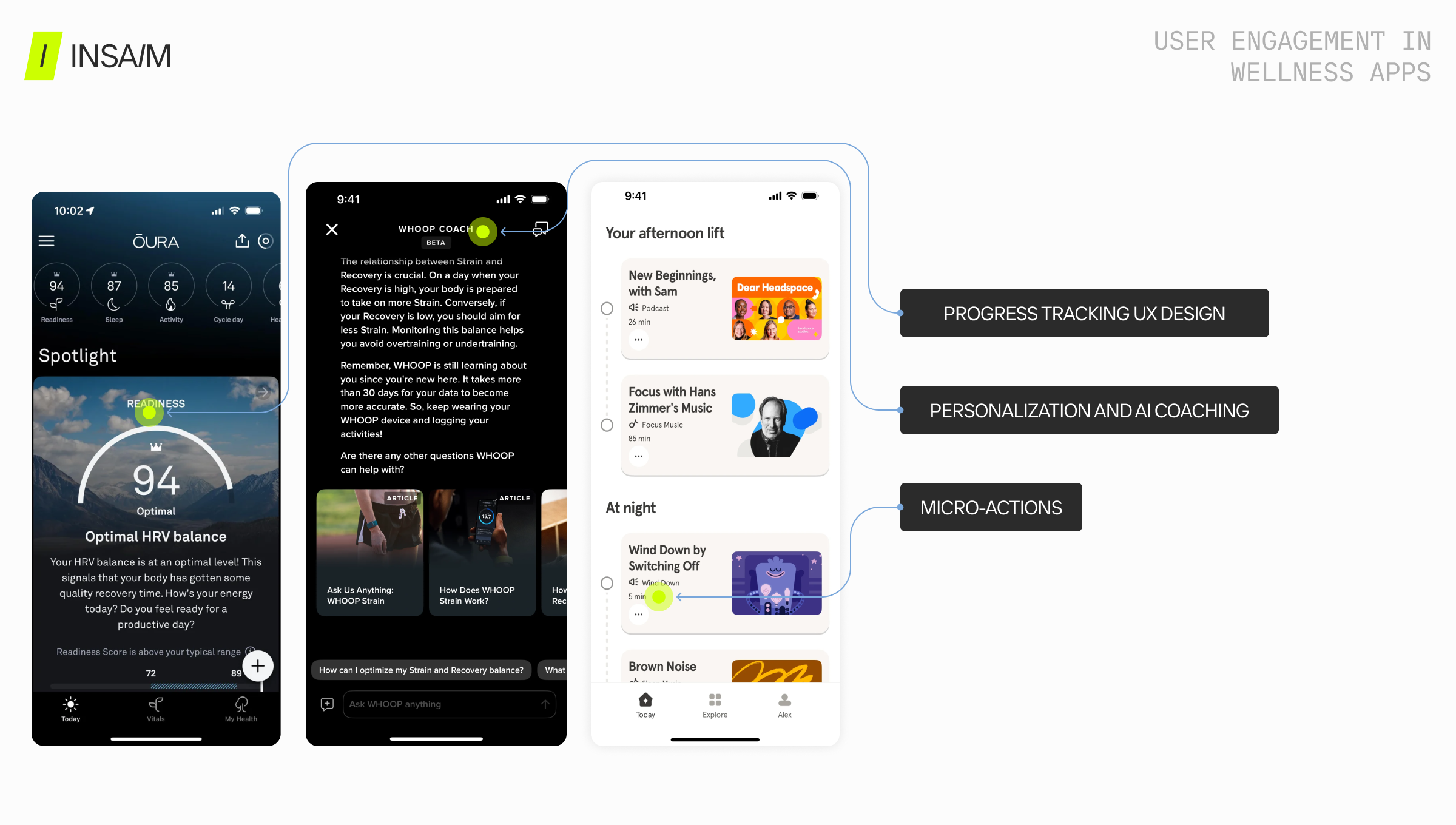
One of the most powerful mechanics in progress tracking UX design is giving users the ability to see their own progress — not just as raw numbers, but as interpreted, actionable feedback. The best products don't just show current metrics; they explain what influenced the result and what actions will help improve it going forward. This turns data into useful feedback and helps sustain motivation over time.
Examples:
- Oura — Readiness Score, Sleep Contributors, Reports
- WHOOP — Recovery, Strain, and personalized recommendations
- Fitbit — Morning Brief and Readiness Score
- Habitify — completion rate and weekly progress.
Personalization and AI Coaching
Modern wellness apps are gradually evolving from trackers into personal assistants. Rather than simply collecting data, they help interpret it and offer recommendations based on the individual user's patterns. As AI capabilities develop, these recommendations become more contextual and timely — and interacting with the app begins to feel more like talking to a coach.
Examples:
- Oura Advisor
- WHOOP Coach
- Headspace Ebb
- Noom AI Coach
- MyFitnessPal AI Meal Scan.
Micro-Actions
The less effort an action requires, the more likely the user is to repeat it tomorrow. Successful products break big goals into small steps: short practices, quick check-in flows, simple daily tasks. This approach helps build habits without triggering a sense of overwhelm.
Examples:
- Calm Daily Calm
- Fitbit Reminders to Move
- Fabulous Daily Rituals
- Headspace Daily Practice
- Daylio Mood Check-in.
Onboarding That Demonstrates Value
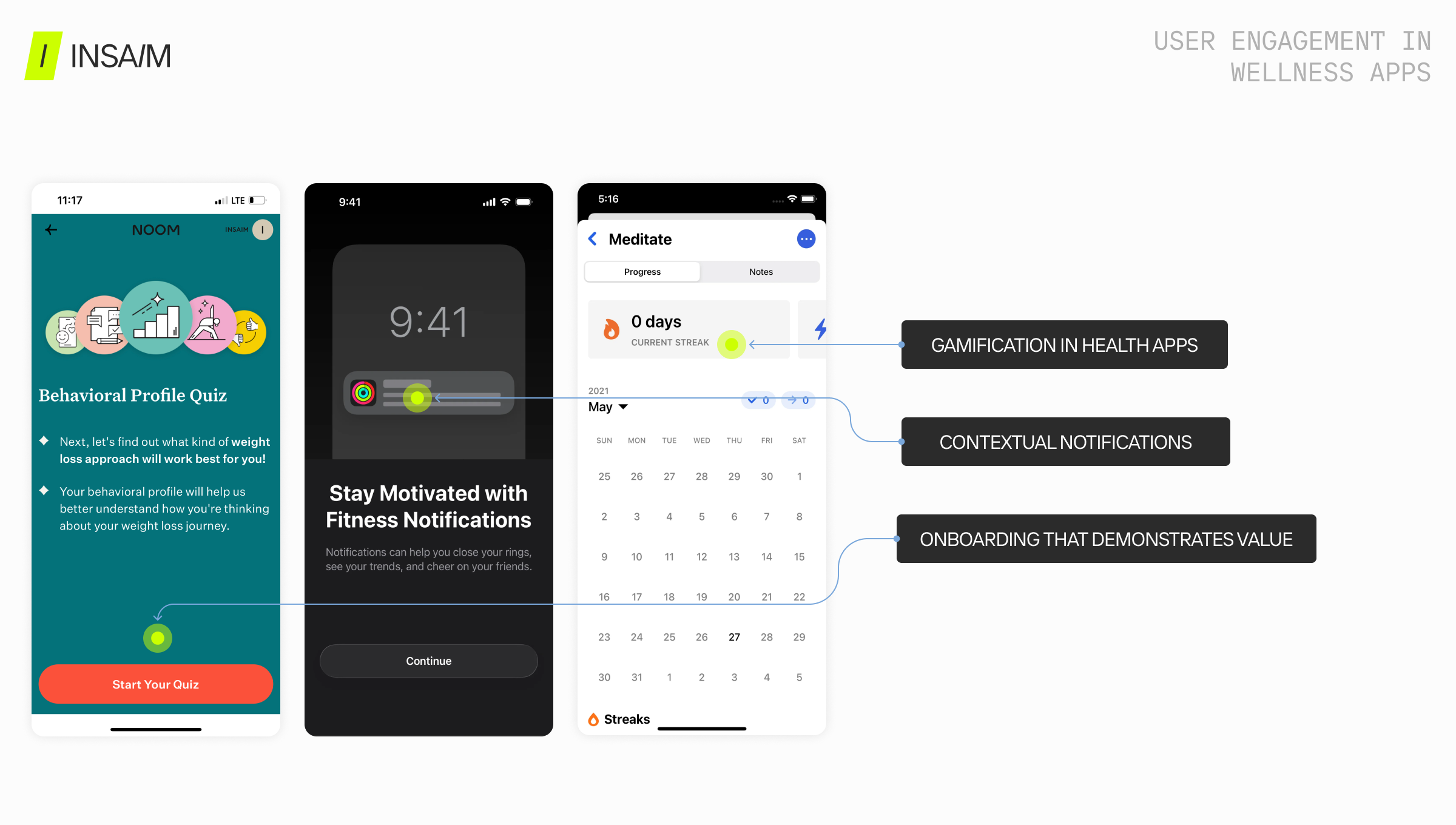
Strong onboarding doesn't explain how the app works — it shows what the user will gain. Rather than a feature tour, the best products help users reach their first useful outcome quickly, set realistic expectations, and give a clear reason to come back tomorrow.
Examples:
- Headspace Goal-based Onboarding
- Calm Beginner Programs
- Noom Goal Quiz
- WHOOP Baseline Period
- Oura Personal Goals.
Contextual Notifications
Notifications remain an important engagement tool — but only when they arrive at the right moment and carry real value. The best wellness products use notifications as support, not as a way to constantly remind users they exist.
Examples:
- Headspace Mindfulness Reminders
- Calm Bedtime Reminders
- Fitbit Reminders to Move
- Habitify Smart Reminders
- Fabulous Routine Notifications.
Gamification in Health Apps
When used effectively, gamification in health apps amplifies engagement rather than replacing it. Social mechanics, achievements, and streaks work best as a complement to intrinsic motivation — when a user already sees real progress, these tools reinforce it. Without that underlying progress, even the most polished gamification loses its appeal quickly.
Examples:
- Oura Circles
- Habitify Circle
- Fabulous Challenges
- Noom Community
- Duolingo Streaks as the benchmark for light gamification.
How to Measure Engagement in Wellness Apps
Measuring engagement in wellness products is more complex than in most other app categories. High open rates don't necessarily mean the product is delivering value, and daily use doesn't always indicate a formed habit or genuine behavioral change.
Successful teams look beyond standard product metrics — retention at D1, D7, and D30, DAU/MAU ratio, and churn rate. Equally important are: time to first value, completion of key onboarding actions, consistency of tracking, use of personalized recommendations, and return rates to core product flows.
The particular challenge in wellness is that many products only start delivering value after enough data has accumulated. This is precisely why the first 7 days are critical. If users don't understand why they should continue tracking before the first insights appear, churn risk spikes sharply.
There's another complication: engagement doesn't always correlate with outcome. A user can open the app daily without changing their behavior at all. Mature products therefore evaluate not just feature usage but the quality of that usage — whether users follow recommendations, return to daily rituals, and actually derive value from personalized insights.
Ultimately, the goal of a wellness product isn't to increase the number of app opens — it's to help users build better habits and achieve meaningful change. That's why engagement metrics must always be considered alongside user value and long-term retention.
Best Practices and Design Principles
Looking across market leaders, successful wellness products share a set of common principles regardless of their specific focus.
- First, users must see value as early as possible. Real changes in sleep, stress, or physical activity can take weeks — so showing intermediate progress matters: early insights, completed actions, formed streaks, or personalized recommendations.
- Second, data must support decision-making. More metrics don't make a product more useful. The most successful apps surface only the indicators that help users understand their current state and identify their next step.
A closely related principle: turn data into action. Knowing you slept poorly or are experiencing high stress isn't enough — users need to understand what they can do today to improve the situation. This is why modern wellness products increasingly evolve from trackers into personal assistants and coaches.
It's also important to recognize that habit formation is rarely linear. Users miss workouts, forget to log habits, and fall out of routines. A good product doesn't punish them for this — it helps them return without guilt and without having to start from scratch.
- Finally, personalization must remain clear and transparent. The more an app influences health-related decisions, the more important it is to explain where recommendations come from — and to avoid creating a false sense of medical expertise where none exists.
The core conclusion is straightforward: engagement doesn't emerge when an app forces users to return more often. It emerges when the app helps them reach their goals with minimal effort and maximum benefit.
Conclusion
Engagement in wellness apps isn't built on the volume of notifications, badges, or graphs. The features that improve user engagement in wellness apps share one common trait — they deliver clear value with minimal friction. Users stay where they see their own progress, understand what actions will help them reach their goals, and trust the insights the product provides. That's why successful products prioritize quality progress tracking UX design, meaningful gamification in health apps, personalized recommendations, simple daily flows, and continuous experimentation — finding the interaction mechanics that genuinely resonate with their audience.
FAQ
- Why do most wellness apps fail to retain users after the first week?
The first 7 days are the most critical period for any wellness app. If users don't experience a clear benefit, see early progress, or understand how the product helps them reach their goals within that window, motivation fades before a habit has had a chance to form. - What are the most effective features that improve user engagement in wellness apps?
The features that consistently drive long-term engagement are progress visualization with actionable feedback, personalized AI coaching, micro-actions that reduce daily effort, contextual notifications, and gamification tied to real behavioral progress — not virtual rewards disconnected from actual results. - How does progress tracking UX design affect long-term app retention?
Poor progress tracking UX shows users raw numbers without context. Effective progress tracking UX design interprets data — explaining what influenced a result and what the user can do next. This transforms tracking from a passive log into a feedback loop that sustains motivation over time.
- What is the right way to use gamification in health apps?
Gamification in health apps works when it reinforces progress the user already feels. Streaks, achievements, and social challenges amplify intrinsic motivation — but when used as a substitute for real value, they lose their effect quickly. The most successful products treat gamification as a layer on top of genuine outcomes, not a replacement for them.
- How should wellness apps measure engagement beyond open rates?
Open rates and daily active users alone don't indicate whether a product is delivering value. Mature wellness products track time to first value, consistency of tracking behavior, whether users act on personalized recommendations, and return rates to core daily flows — measuring the quality of engagement, not just its frequency.