.svg)
.png)
.svg)
.svg)
.svg)


The best UX design agencies for AI products in 2026 aren't the ones selling a new specialty. They're the ones with enough UX depth to design for less. That sounds backwards, because most of the conversation around AI design treats it as a frontier — a fresh set of patterns you can only learn by shipping language-model interfaces. The truer version is quieter: designing for AI is mostly an exercise in restraint, and restraint is the hardest thing to do well. It takes a team that has already seen what too much looks like.
A weak AI product floods the user with everything the model can do. A strong one understands what the user needs in this moment and removes the rest. That instinct doesn't come from an "AI" badge on a service page. It comes from years of watching real people get confused, hesitate, and abandon — and learning, case by difficult case, what to take away. That is what a digital product design agency with experience in AI interfaces actually brings: not a novel trick, but old UX discipline applied harder.
So the question to ask isn't "have you built an LLM chat box before." It's "do you understand how people behave when they're uncertain, and can you structure a workflow so the product earns trust before it asks for any." This guide covers why AI design is really a test of UX maturity, how to evaluate that maturity, and seven UX design agencies with AI product development experience worth a conversation in 2026.
Why designing for AI is really a test of UX maturity
There's a myth that AI interfaces require a separate rulebook. They don't. They require the standard UX rulebook held to a higher standard, because the stakes of getting it wrong are higher and more visible.
Consider what actually breaks in AI products. Users don't know what the system will do, whether to trust what it returned, or what happens if they act on a wrong answer. None of those are new problems. They're the oldest problems in UX — clarity, trust, error recovery — just made sharper because the system is probabilistic rather than predictable. A button click produces the same result every time; a model's output varies, confidence fluctuates, and errors are statistical rather than binary. That doesn't demand a new discipline. It demands a mature one.
The work, concretely, is subtraction. A few examples of where it shows:
- Uncertainty, communicated by restraint. A traditional interface shows a result. An AI interface has to show a result and signal how much to trust it — without burying the user in probability language they'll ignore. The skill isn't adding confidence scores everywhere. It's knowing the one moment a confidence signal matters and staying silent the rest of the time. That judgment is built from having over-explained before and watched users tune it out.
- The "what now" moment, designed away. A user receives an output and stalls: trust it, refine it, act on it? The instinct of an immature team is to add buttons, tooltips, a tour. The instinct of a mature one is to structure the workflow so the next step is obvious and the stall never happens. Knowing the difference is knowing how users behave under uncertainty — which is general UX expertise, not an AI specialty.
- Trust, built before the first output. In AI products, trust is frequently the primary conversion metric, not feature discovery. And trust is built before the first data point arrives — in how onboarding frames what the product will do, how it handles permissions, how honestly it sets expectations. Teams that have done deep research on how people decide to trust software do this instinctively. Teams that haven't bolt a disclaimer on at the end.
- Empty and error states, treated as core surfaces. When a system can be confidently wrong, error and empty states aren't afterthoughts — they're where the relationship survives or dies. Most teams skip them. The ones who don't are the ones who've been burned by skipping them before.
Every one of these is a known UX problem. What makes AI hard is that there's no slack: a confusing dashboard is annoying, but a confusing AI product feels untrustworthy, and untrustworthy is fatal. So the filter isn't "have they designed AI" — it's "do they have the UX depth that makes designing for less possible."
How to evaluate a UX agency for an AI product
If the real qualification is UX maturity rather than an AI label, the evaluation criteria change — and the top UX agency for your AI product may not be the one that markets AI loudest. Here's what to actually probe for:
- Depth of research, not breadth of portfolio. Ask how they figure out what users need at each moment — interviews, usability testing, behavioral analysis. An agency that leads with research has the foundation to design for less. One that leads with visuals will give you more, polished.
- Evidence they understand behavior under uncertainty. The right question isn't "show me your AI work," it's "tell me about a time users didn't trust a product and how you diagnosed why." Designing AI interfaces is designing for hesitation, confusion, and the decision to trust. Agencies that can talk fluently about user psychology are the ones equipped for it.
- Ability to structure a workflow, not just style screens. A lot of AI UX failure is workflow failure — the product technically works but the path through it is wrong. Ask how they'd sequence a flow so the product earns trust before asking for commitment. Strong answers are about structure and order; weak ones are about layout and color.
- A clear answer on who runs your project. Ask who leads the work, whether you'll meet them, and what went wrong on a past project and how they handled it. Maturity shows in how a team talks about its failures, not its wins.
- Engagement fit. A 0→1 build, a redesign of an existing AI product, and an AI feature added to a mature platform are three different problems. Match the agency's actual track record to the one you have.
Top 7 UX agencies for AI products in 2026
The agencies below were selected for UX depth, clarity of method, and fit across different stages and budgets — not for an AI label. They're grouped loosely by where each is strongest rather than ranked as a strict ladder. The "best" UX agency here is the one whose maturity matches your stage, your domain, and the kind of trust your product has to earn.
1. INSAIM
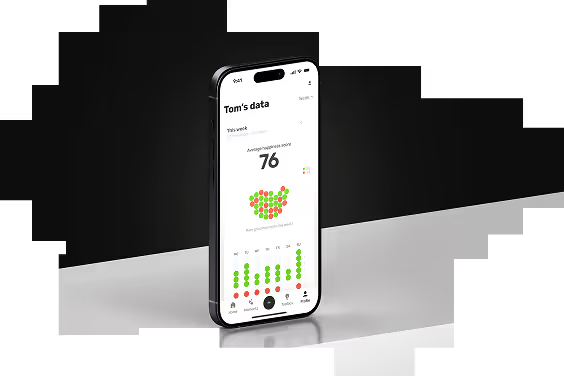
INSAIM is a Lisbon-based branding, UX/UI, and product design studio whose strength is exactly the kind of restraint AI products demand. INSAIM's healthtech work centers on the hard, quiet problems: onboarding that builds trust before the first data point arrives, empty and uncertainty states most teams skip, and dense data made legible by taking things away rather than adding them. That instinct comes from deep research into how people actually behave in moments of uncertainty — the foundation AI design rests on. The studio has shipped companion apps for continuous-monitoring and integrative-health products (Aura, WellO), 0→1 builds, and SaaS product pages, pairing research-led UX with brand and Framer/Webflow development under one roof.
Best for: Healthtech, B2B and AI companion products that need research-led UX plus brand and build in one partner.
Strengths: Trust-first onboarding, uncertainty and empty-state design, behavioral research depth, Framer Partner and Webflow Partner delivery.
Engagement fit: 0→1 builds and existing-product optimization, both handled distinctly.
2. The Gradient
The Gradient is a small, focused multidisciplinary team that grounds its work in behavioral science before it touches an interface — which is why its AI products feel considered rather than crowded. A fit for teams that want behavioral rigor and award-grade craft with an international perspective.
Best for: Companies launching AI-native digital products.
Strengths: Behavioral-science grounding, rapid prototyping, back-to-back UX Design Award–winning interfaces.
3. Lazarev.agency
Lazarev agency – a 30-person studio split between Kyiv and San Francisco whose core skill is the AI design skill: making dense, complex output legible enough to grasp in seconds. Across roughly nine years they've shipped many products are the strongest where the challenge is reducing complexity to clarity, fast.
Best for: Data-heavy AI SaaS and analytics products that need investor-ready clarity.
Strengths: Reducing complex data to legible interfaces, speed to click-ready prototype, Webby-recognized work.
4. 925Studios
925Studios is a UI/UX agency working with AI startups, SaaS, fintech, and web3, with a stated focus on the "what now" moment — the post-output stall that kills retention. That focus is telling: it's a workflow problem, not a styling one, and they treat it as such. A good fit for seed-to-Series-B AI companies that need speed without losing rigor.
Best for: Early-stage AI startups (seed to Series B).
Strengths: Workflow-led methodology, startup velocity, focus on the post-output handoff.
5. Glow
Glow is a faster-moving SaaS execution shop suited to early-stage AI products and MVPs that need to ship without losing rigor. A fit for idea-to-prototype and startup-MVP stages where speed matters and the product surface is still taking shape — and where a disciplined team keeps "fast" from becoming "cluttered."
Best for: Early-stage AI startups and MVPs needing fast SaaS execution.
Strengths: Speed, SaaS focus, disciplined prototype-stage delivery.
6. Zypsy
Zypsy is a design studio built around early-stage founders, operating as an integrated brand-and-product team rather than a project vendor. Zypsy's portfolio is heavy with AI and data-infrastructure companies. Working that close to technically complex products demands the discipline to simplify rather than showcase. A fit for venture-backed AI startups that want brand and product built together from the start.
Best for: Venture-backed early-stage AI and data-infrastructure startups.
Strengths: Integrated brand-plus-product team, complex-product simplification, founder-stage focus.
7. Excited
Excited is a product design agency working across SaaS, web, and mobile, anchored by genuine UX craft and a deep award shelf (Webby, Red Dot, Awwwards, CSS Design Awards). Their work includes Artificial Societies, an AI-powered social-simulation platform recognized by Awwwards and the CSS Design Awards. A fit for AI SaaS and consumer products that need usability and visual craft to land together, with brand and Webflow build in-house.
Best for: AI SaaS and consumer products wanting award-grade UX, brand, and build together.
Strengths: Product design plus branding and motion, strong usability and visual craft, full in-house build.
How much does AI product UX cost in 2026?
Pricing varies widely by scope and agency tier, but published market signals put most AI product engagements in roughly the $15,000 to $80,000 range, with boutique and early-stage-focused studios at the lower end and enterprise-grade firms above it. Hourly rates across the category commonly run from around $50 to $150+. The more useful number isn't the rate — it's the cost of getting it wrong. Buyers often start by searching "top 10 UX agencies" and optimizing for the cheapest competent option, but the expensive mistake in AI design isn't overpaying for a senior team. It's hiring one that adds when it should subtract, and paying again to fix trust, clarity, and error handling after launch.
Choosing the right partner
There's no shortage of impressive portfolios, and in 2026 nearly every UX agency has an AI page. The distinction that matters isn't who claims AI expertise — it's who has the UX maturity to design for less: to understand what users need at each moment, structure a workflow that earns trust, and have the discipline to leave the rest out.
Start from your actual problem. A healthtech companion app, an enterprise dashboard, and a seed-stage AI MVP each point to a different agency on this list. Then probe for depth, not breadth — ask how they research behavior, how they handle uncertainty, how they decide what to remove. The right partner is the one whose answer is about the user, not the model. That's how you end up with one of the best UX agencies for the job you actually have, not the one a ranking assumes you have.
FAQ
- What are the best UX design agencies for AI products in 2026?
The seven covered in this guide — INSAIM, The Gradient, Lazarev.agency, 925Studios, Glow, Zypsy, and Excited — each earn the spot for UX depth rather than a marketing label, and each fits a different stage and domain. There's no single best UX agency for every AI product; the right one depends on whether you're building a healthtech companion app, a data-heavy SaaS tool, or a seed-stage MVP, and on whether you need brand and build alongside the UX. - What makes a good UX design agency for an AI product specifically?
Less than people assume, and more than a checklist of AI keywords. The work that breaks AI products — communicating uncertainty, designing the moment after an output, earning trust before the first result, handling errors gracefully — is standard UX held to a higher standard. The agencies that do it well are the ones with deep research practices and real experience watching users behave under uncertainty, not the ones with the newest "AI" page. - Do I need a specialist AI agency, or can a strong general UX agency do it?
A strong general UX agency with genuine maturity is often the better choice. Designing for AI is largely about restraint — knowing what to remove so the user isn't overwhelmed — and that instinct comes from years of difficult cases, not from an AI specialty. What you should avoid is a thin team in either category: a generalist who only styles screens, or a "specialist" whose AI experience is a chatbot wrapper. Look for UX design agencies with AI product development experience grounded in research and workflow design. - How do I evaluate a digital product design agency with experience in AI interfaces?
Probe for depth, not portfolio breadth. Ask how they discover what users need at each moment, how they've diagnosed a trust problem before, and how they'd structure a workflow so the product earns trust before asking for commitment. Strong answers are about the user, research, and structure. Weak ones are about layout, color, and how many AI logos they can show you. - How much does it cost to hire a UX agency for an AI product?
Most AI product engagements fall in roughly the $15,000 to $80,000 range depending on scope and agency tier, with hourly rates commonly between $50 and $150+. The larger cost is usually the one that doesn't appear on the invoice: redesigning trust, clarity, and error handling after launch because the first team added complexity instead of removing it.